Mortal Kombat
An Old School(-ish) Magic Event
One-Time Special Event
Friday, May 15, 2026
Time: 6PM-10PM-ish
Rules Publication Date: Feb 26, 2026
Rules Status: Open For Feedback
Mortal Kombat Rules
In Mortal Kombat, you take on the role of one of the seven original Mortal Kombat Fighters and choose a home Arena on which to face your adversaries. By employing your deadly Soul Moves and taking advantage of the unique features of the Arena in which you face your opponents, you can kill them and even perform a Fatality against a defeated opponent, weakening them for the rest of the tournament. To power all of these abilities, you need to consume the Souls of your opponent and their minions.
Players will be given a copy of all Fighters and Arenas at the event to play this ruleset. Players will also be given copies of any 0/1 Soul spells they need to use during the event.
Deck Construction & Mechanics
Deck construction follows standard PAC rules, with the addition of three unique mechanics: Arenas, Fighters, and Fatalities.
Arenas
Arenas are similar to Planechase cards. There are a total of six Arenas. Each player must choose one Arena to act as their home Arena. Whenever a player is on the draw, the game begins in their home Arena. The Arena may change over the course of the game as a result of Arena Shift abilities (see below).
Each Arena has a static effect on the game as long as it is active. Pairing your Fighter with a home Arena results in considerations you will want to take into account when building your deck.
Fighters
Each player is required to choose one Fighter for the tournament. If you are familiar with modern Magic sets, Fighters are similar to Planeswalker cards with a dash of Companions thrown in. However, the biggest difference is that in Mortal Kombat, you are the planeswalker. Your Fighter is represented by a card in exile, but that card has persistent in-game effects and cannot be removed, destroyed, or interacted with in any way.
Fighters have several effects on the game unique to the Mortal Kombat ruleset, affecting both gameplay and deckbuilding decisions you will have to make. As long as you meet the Fighting Requirements of your Fighter, you may use their abilities.
Arena Shift
Fighters have an ability which can be used to change the Arena a game is taking place in. This ability is called Arena Shift.
Arena Shift: At the beginning of your upkeep, you may pay {1 + X} colorless mana, where {X} is equal to the number of times any player has used Arena Shift this game. If you do, roll a d6:
- 4-6: The Arena becomes your home Arena
- 2-3: The Arena becomes a random Arena (roll another d6 to determine the Arena, referring to the number in the top left of the Arena card to find its number)
- 1: You lose 2 life
Souls
Fighters use a resource called Souls to perform their abilities and grant you the option to use Fatalities to both improve your overall tournament standing and harm your opponent's. If you are familiar with modern Planeswalker cards, Souls are like loyalty counters except you earn them in different ways, and they affect the overall tournament by allowing players to perform Fatalities for extra match points.
Players begin every game with 0 Souls. To gain Souls, Fighters have a special ability called Your Soul is Mine. It reads:
Your Soul Is Mine: Any time:
- A creature you control deals combat damage to an opponent,
- You spend Souls to deal damage to your opponent, or
- A creature an opponent controls dies or is exiled,
You gain 1 Soul for each such occurrence.
Note that to qualify as "spending Souls to deal damage to your opponent," spending Souls must be a necessary step to the damage being dealt. For example:
- Spending Souls to deal direct damage to your opponent
- Spending Souls to give a creature trample AS LONG AS that creature didn't already have trample (because if it did, it wasn't necessary to spend Souls to give it trample)
- Spending Souls to give a creature double strike, leading to your opponent being dealt damage twice, yields 3 total Souls: 2 for dealing damage to the opponent twice, and an additional Soul for the fact that spending Souls was necessary to deal damage one extra time
Soul Moves
Your Fighter grants you the ability to use their Soul Moves, which you perform by spending Souls. If you have enough Souls to pay for it, you can spend Souls to use one Soul Move once per turn any time you could cast a Sorcery (unless otherwise indicated; the Reflex keyword below is the only relevant effect in the format). All Fighters have one each of -1, -2, and -3 Soul Moves, plus a Fatality you can use any time you win a game with enough Souls left over to attempt it.
Some Soul Moves have the Reflex keyword, which means you may use them any time you could cast an Instant instead of when you could cast a Sorcery (including on your opponent's turn, but still only once per turn). Every Fighter has exactly two Reflex Soul Moves.
All Fighters thus have the following basic structure:
Fighting Restriction: {reminder text}
Arena Shift, Your Soul Is Mine. Soul Moves:
- -1: Weak ability
- -2: Medium ability
- -3: Strong ability
- Fatality: [Flavor for their Fatality]
with exactly two of those non-Fatality abilities having the Reflex keyword. However, which abilities have Reflex does vary across Fighters, so some Reflex abilities are intentionally stronger than others because they cost more Souls.
If you win a game, you may attempt to perform your Fighter's Fatality (see below). Fatality may only be used when you win a game, provided you meet the Soul requirements to attempt it after a game you win.
Fighting Requirements & Deckbuilding
Fighters impose some type of deckbuilding restriction on your deck beyond normal PAC rulesin the form of a Fighting Requirement. If your deck does not comply with your Fighter's Fighting Requirement, you cannot use their abilities, including gaining Souls via Your Soul Is Mine. This applies to every individual game, so if you sideboard out of your Fighter's Fighting Requirement, you lose their abilities and cannot gain Souls for that game.
Each Fighting Requirements states you must include at least 6 nonartifact creature spells with different names and some other type of restriction in your deck at the start of every game. The Fighter cards include a short reminder of the Fighting Requirement for each Fighter. Fighting Requirements generally mean:
Your deck must include at least 6 nonartifact creature spells with different names and {X}
Where {X} is a specific requirement for that Fighter. Complete Fighting Requirement text is provided with each Fighter below, along with a best-effort Scryfall query to help you identify compliant creatures. Note that the Scryfall links are NOT the definitive list of creatures - it's your responsibility to verify the creatures you are using to satisfy Fighting Requirements are valid. The Scryfall links are mostly comprehensive, but ultimately are just trying to be helpful.
IMPORTANT NOTE: Your deck MAY include creatures that don't comply with your Fighter's Fighting Requirements. Fighting Requirements don't ban any creatures from being in a deck. They only specify what kind of creature you need to play at least 6 of to use your Fighter's abilities and gain Souls.
Fatalities
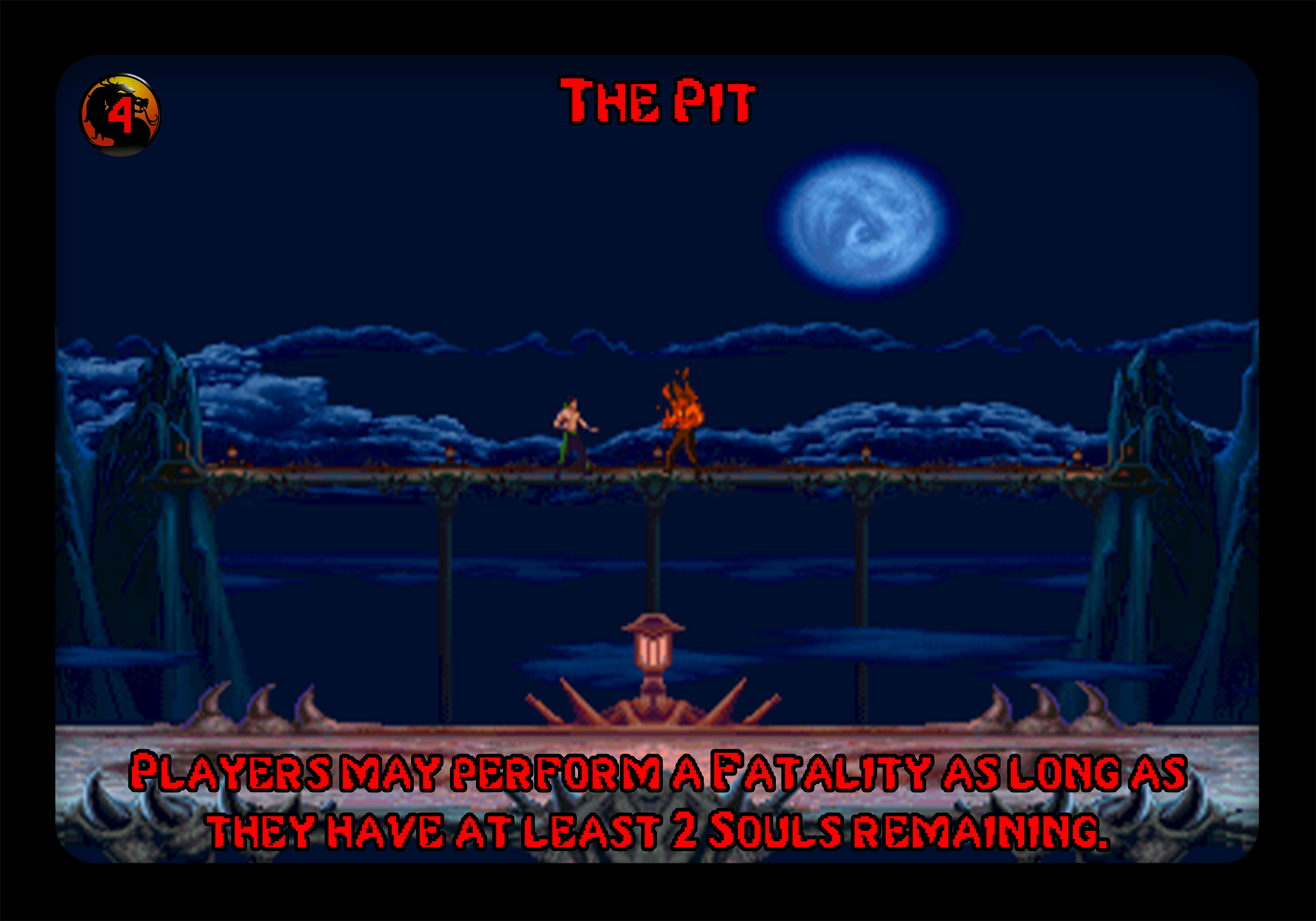
If you win a game and have at least 6 Souls remaining, or your opponent forfeited or conceded the game, or another game effect otherwise allows you to do so (note: the only relevant effect here is the Arena called The Pit, which lets you perform Fatalities with only 2 Souls), you may attempt a Fatality.
Note: The pedantic version of what "attempt a Fatality" means would be along the lines of "If you would win a game, and (a) you have at least 6 Souls [or 2 if The Pit is the Arena], or (b) your opponent conceded or forfeited that game, then you may instead win the game and [do the Orb flip etc. described below]."
To attempt a Fatality, reveal the top 4 cards of your opponent's library. If they do not have enough cards in their library, choose cards from their graveyard or exile to make up the difference. Then, you choose one of those cards. Perform a Chaos Orb flip on the chosen card (even if it's a non-permanent spell, still flip onto the card).
If you make the flip, that card is removed from their deck for the remainder of the tournament, (starting from the next game), and is replaced with a 0-mana cost, 0/1 Soul creature spell (players will be given cards for this). These creatures MAY NOT be sideboarded out, and count as creatures that satisfy all Fighting Requirements for all Fighters; i.e., losing one of your Fighting Requirement creatures to a Fatality will not make you unable to use your Fighter or gain Souls in future games. Players are expected to follow the honor system with regard to removing cards from their deck and including any Soul creature spells they are required to during the event. If they don't, they'll be Fatalitied right out of Seattle.
Additionally, when you successfully complete a Fatality, you gain an additional d6 Match Points for that game, beyond what you would earn for the match. For example, even if you lose a match, if you won a game and made a Fatality, you still gain d6 Match Points. If you won a match and succeeded in completing two Fatalities, you would earn 3+2d6 Match Points.
If you miss the flip, nothing else happens. You simply failed to execute the combo move sequence necessary to perform the Fatality.
Players with any condition that legitimately impairs their ability to perform a Chaos Orb flip may nominate another person to perform their Fatality Chaos Orb flip for them. Merely being bad at flipping Orbs is not a legitimate impairment, but players do not need to disclose any personal or medical issue to use this rule. Any player objecting to someone invoking this rule over their opponent's good-faith assertions, or especially asking for "proof," will also be Fatalitied right out of Seattle. Honor system and good vibes. Don't be a dick; else be dicked upon.
Choose Your Fighter
The seven original characters from Mortal Kombat are available to be chosen as your Fighter. Each Fighter's section defines its EXACT Fighting Requirement; text on the cards is reminder text.
Note: the Scryfall links provided are ADVISORY. Scryfall search queries don't cleanly help filter the list of creatures for all Fighters. You must still ensure your deck is legal under these rules, without relying on the Scryfall links to be definitive.
Liu Kang
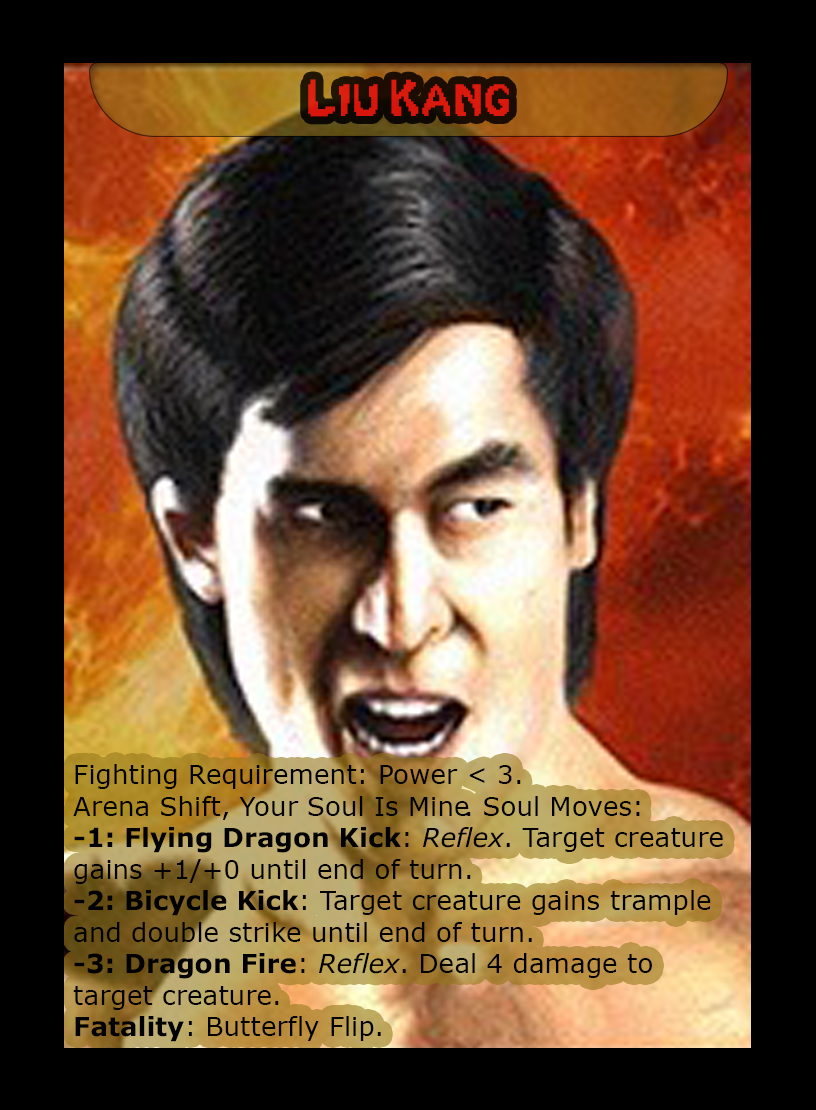
Fighting Requirement: Your deck must include at least 6 nonartifact creature spells with different names and power less than 3. Scryfall link.
Johnny Cage
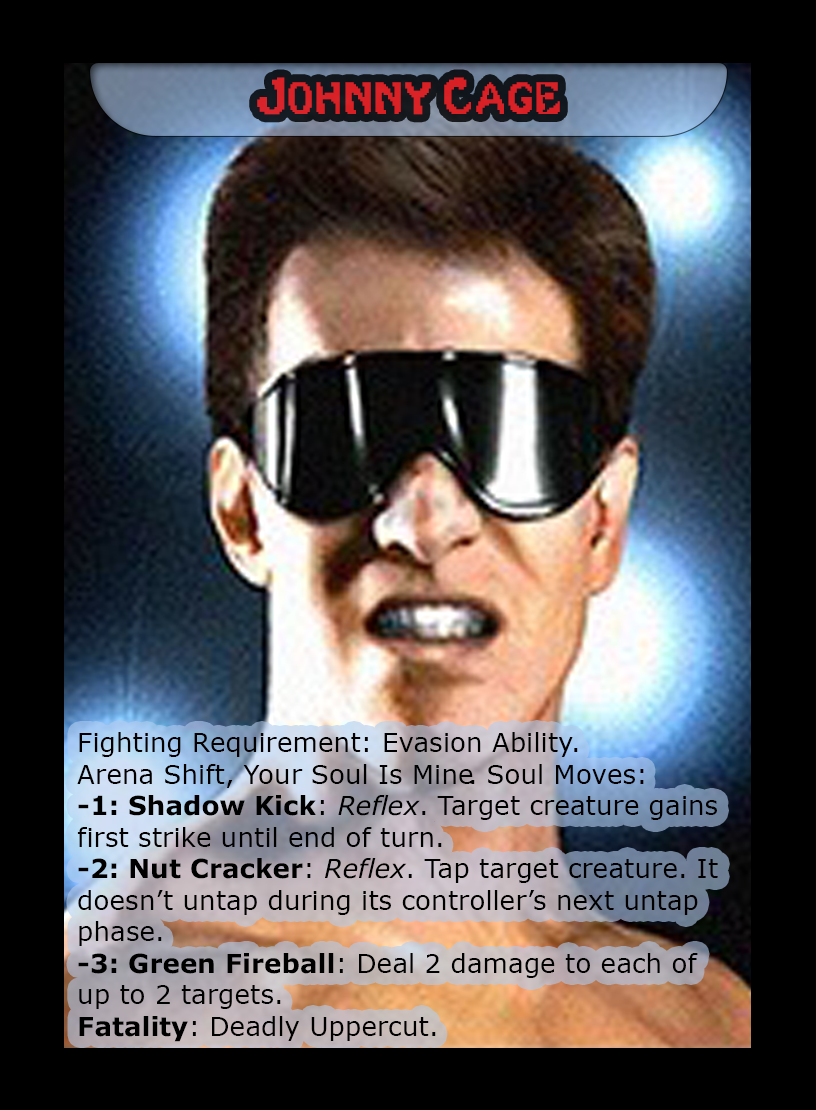
Fighting Requirement: Your deck must include at least 6 nonartifact creature spells with different names and an evasion ability (evasion abilities are any ability that can cause another creature to be unable to legally block it under some theoretical circumstances, such as flying, protection, or landwalk; the ability to merely GRANT a creature evasion, like Stone Giant, doesn't count). Scryfall link (NOTE! THIS IS AN ESPECIALLY APPROXIMATE QUERY! Some of the other Scryfall links are easier to get right, but this one is hard, so it's approximate.)
Sub-Zero
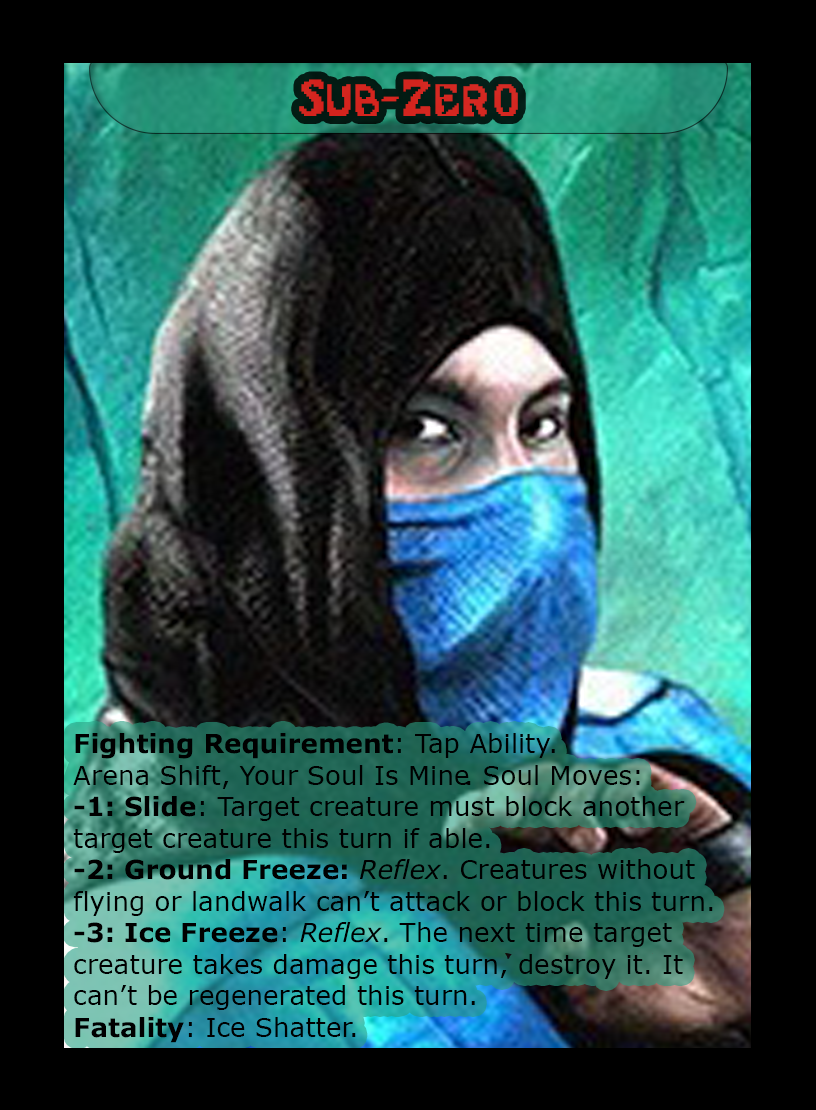
Fighting Requirement: Your deck must include at least 6 nonartifact creature spells with different names and a tap-activated ability. Scryfall link.
Scorpion
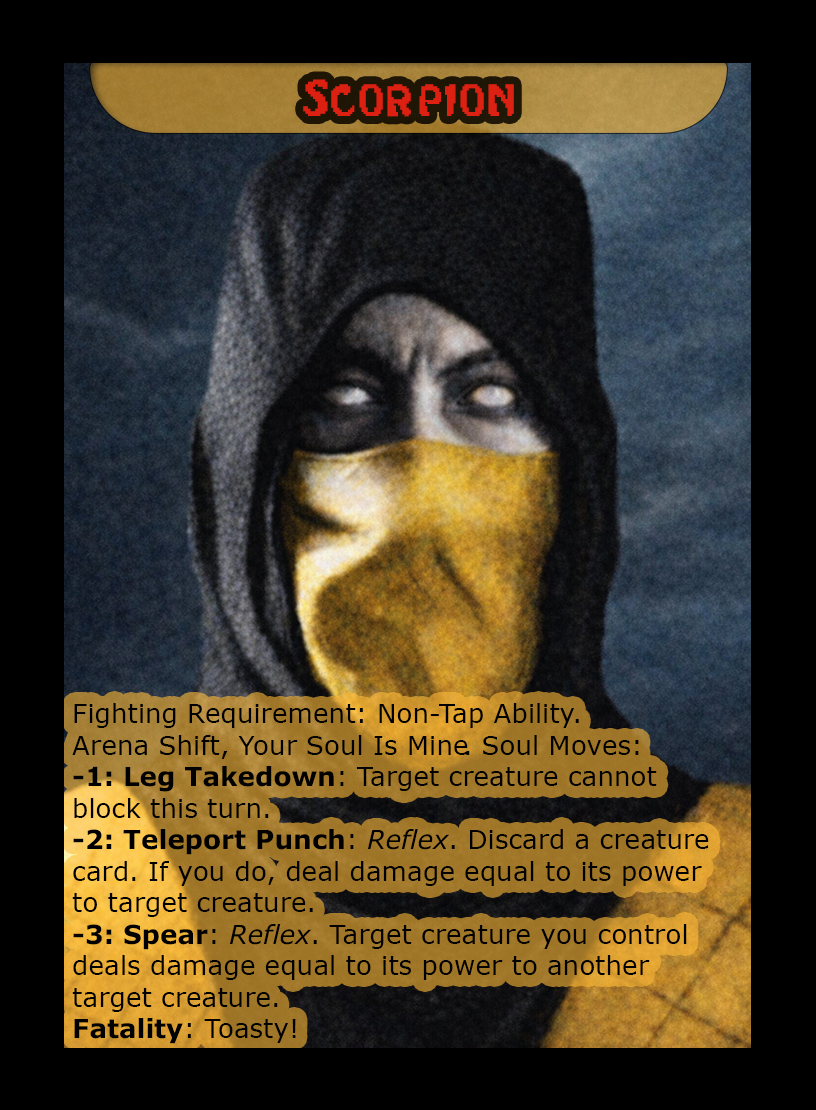
Fighting Requirement: Your deck must include at least 6 nonartifact creature spells with different names and a non-tap-activated, non-keyword ability (keyword abilities are things like "Flying", "Haste", and "Reach"). Scryfall link. (NOTE! THIS IS AN ESPECIALLY APPROXIMATE QUERY! Some of the other Scryfall links are easier to get right, but this one is hard, so it's approximate.)
Raiden
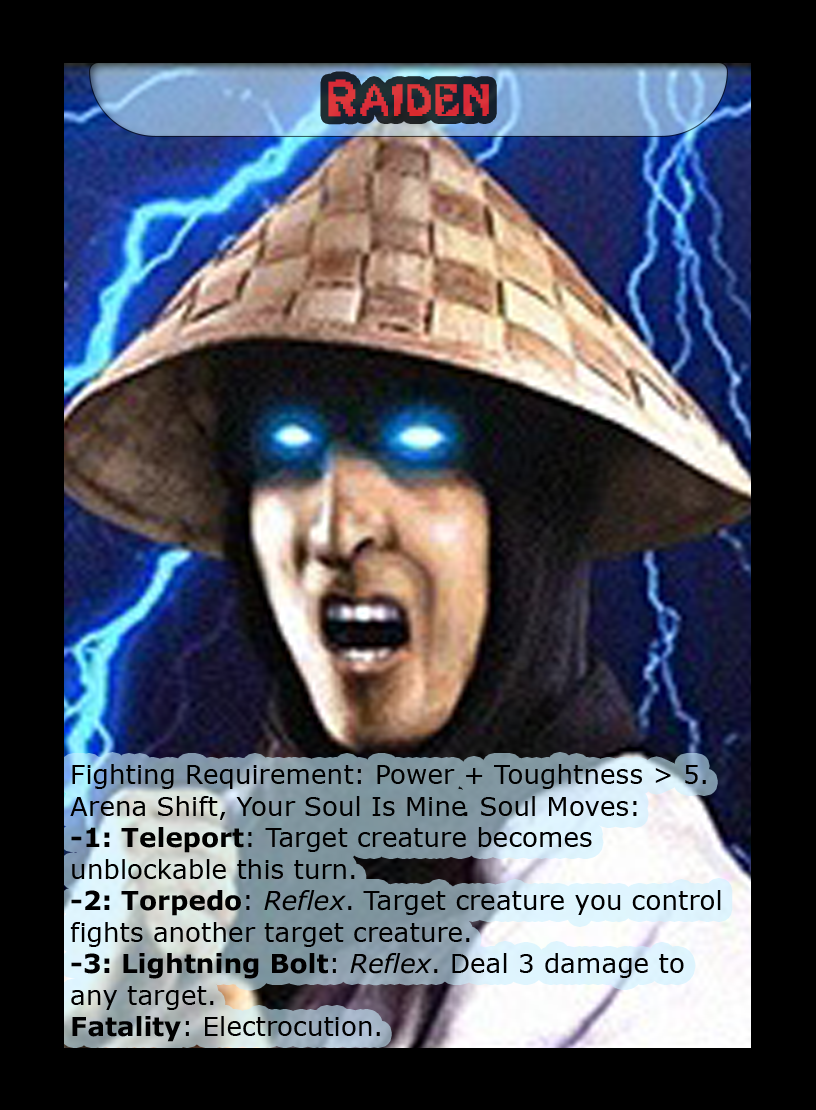
Fighting Requirement: Your deck must include at least 6 nonartifact creature spells with different names and power plus toughness greater than 5. Scryfall link.
Kano
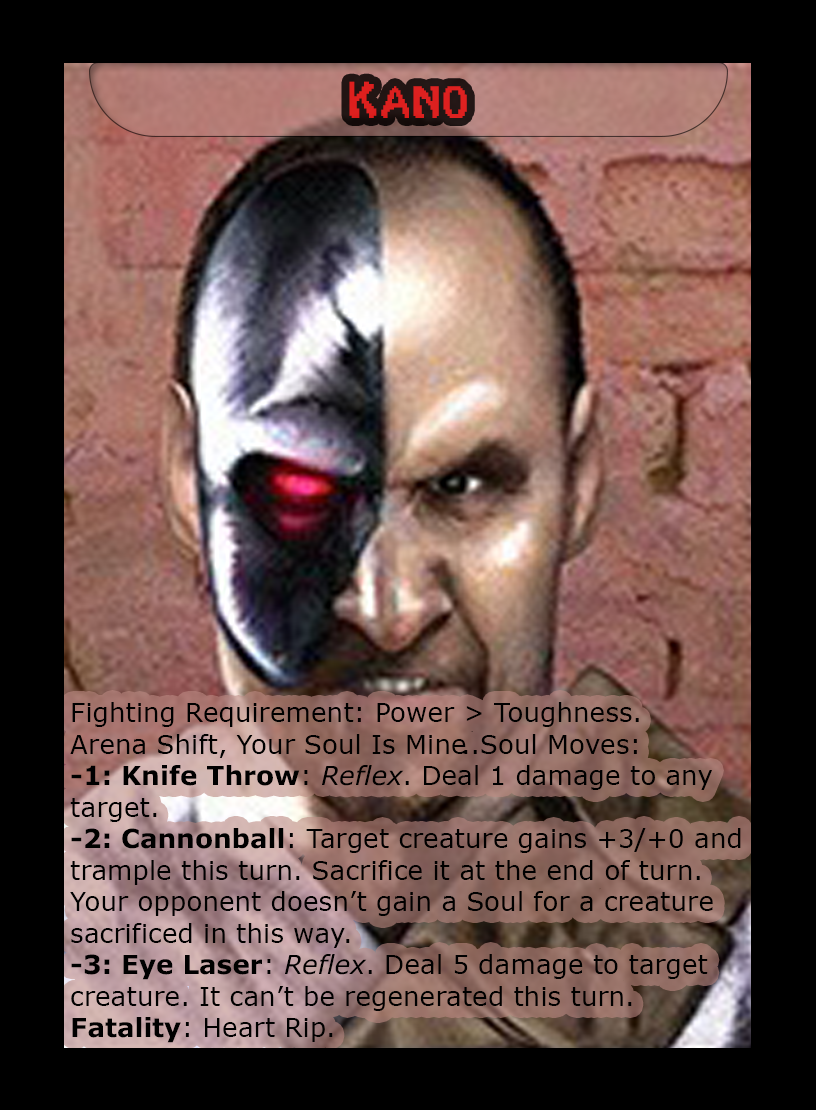
Fighting Requirement: Your deck must include at least 6 nonartifact creature spells with different names and power greater than toughness. Scryfall link.
Sonya
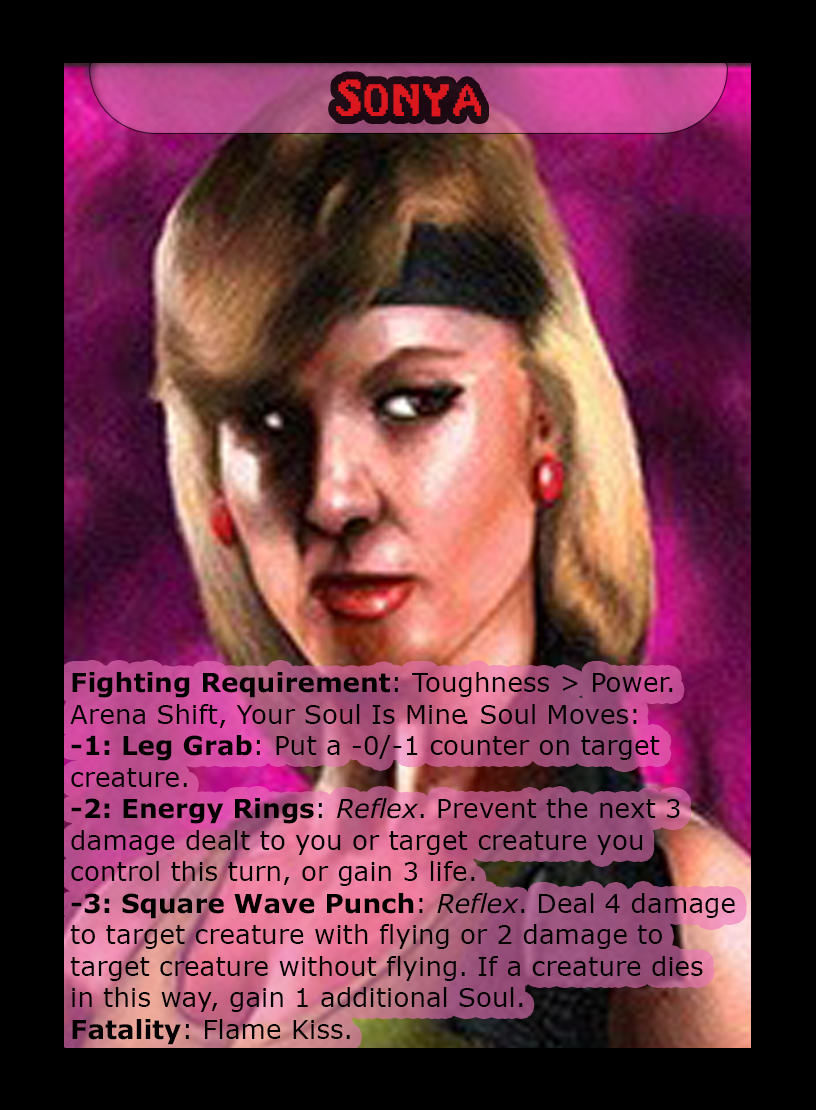
Fighting Requirement: Your deck must include at least 6 nonartifact creature spells with different names and toughness greater than power. Scryfall link.
Choose Your Arena
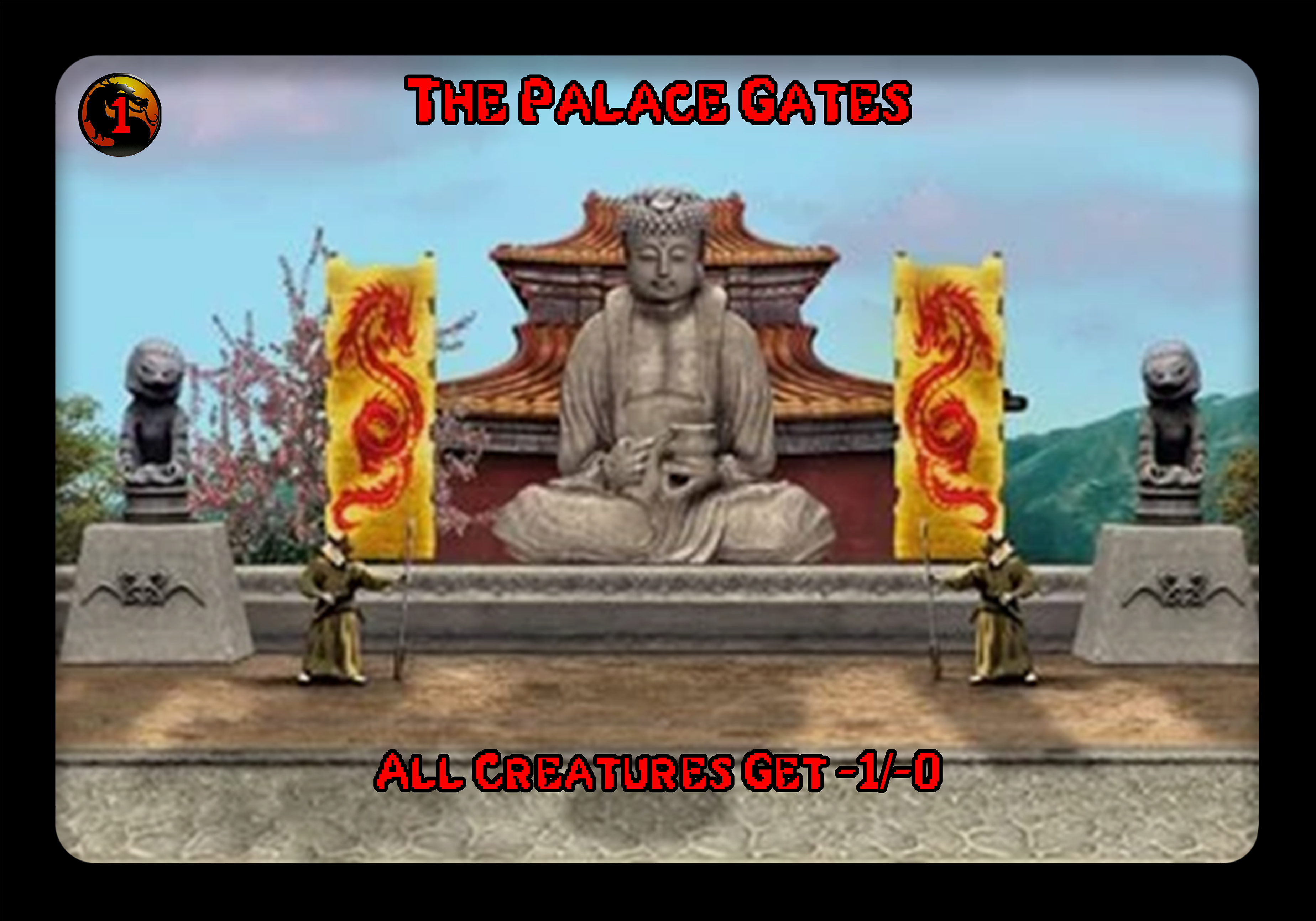
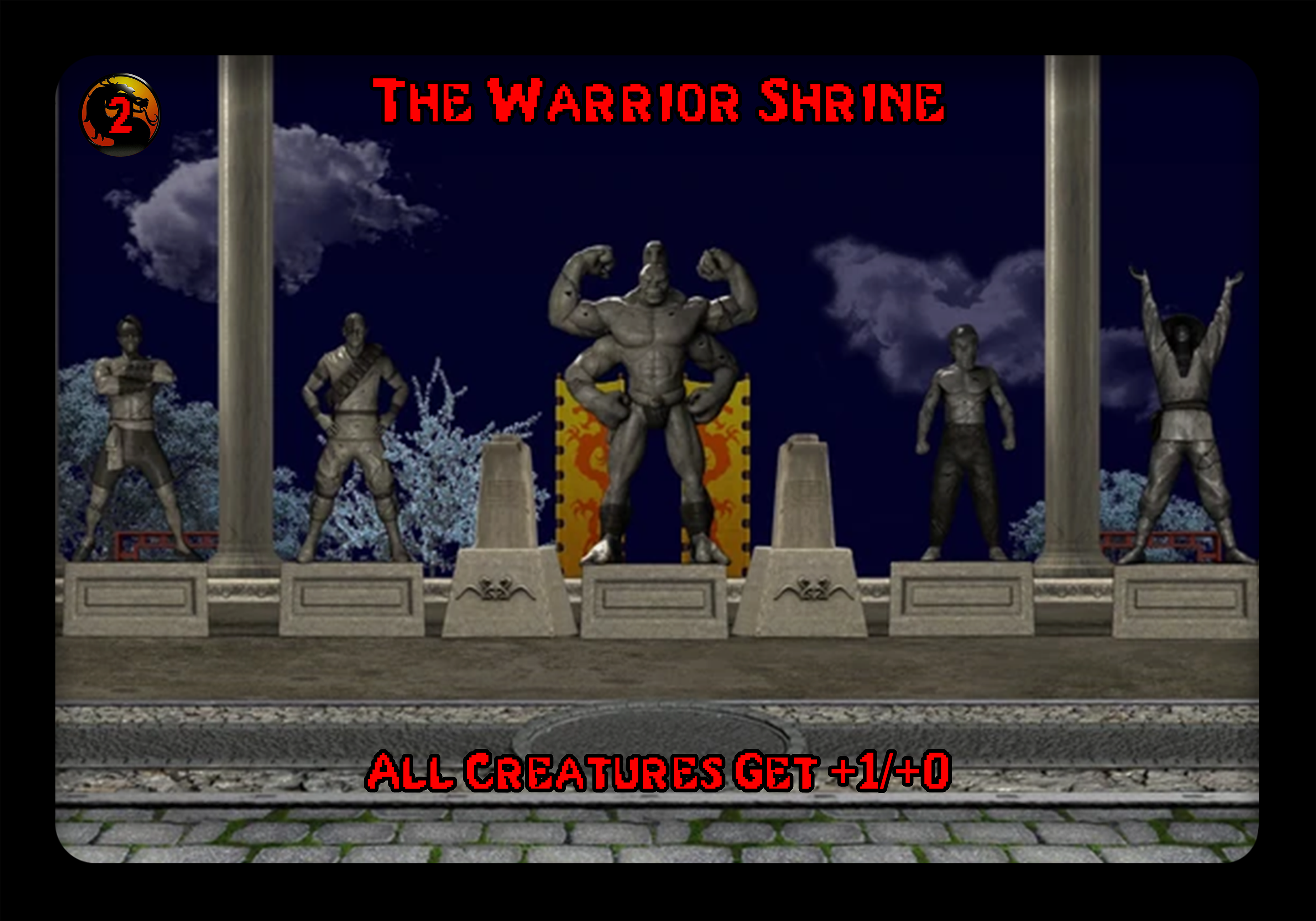
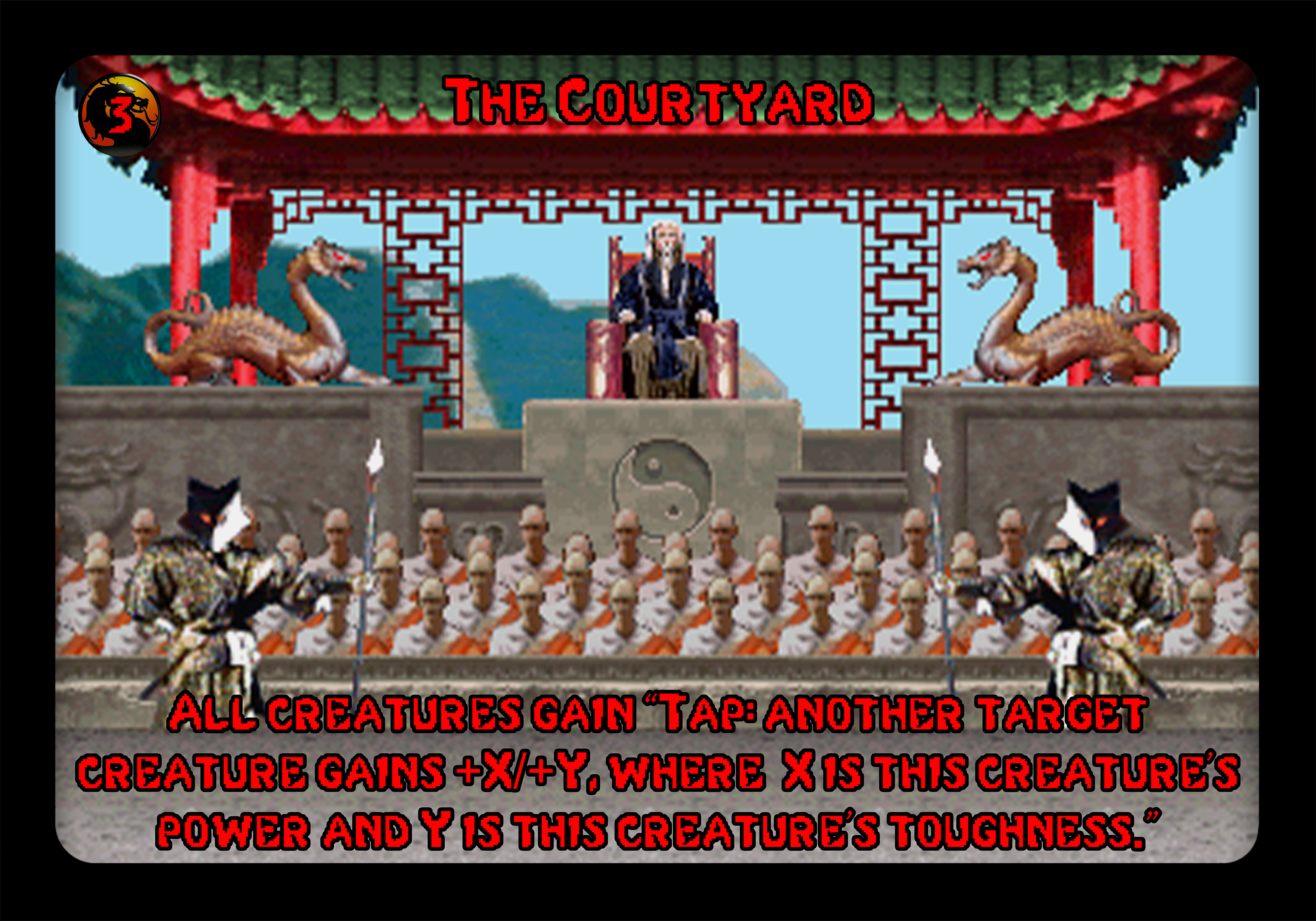
The six original arenas from Mortal Kombat are available to be chosen as your home Arena. Each of them is also assigned a number to make it easy to determine a random Arena due to an Arena Shift ability. The assigned number appears on the upper left corner of the Arena card on top of the Mortal Kombat logo for clarity.
1. The Palace Gates
2. The Warrior Shrine
3. The Courtyard
4. The Pit
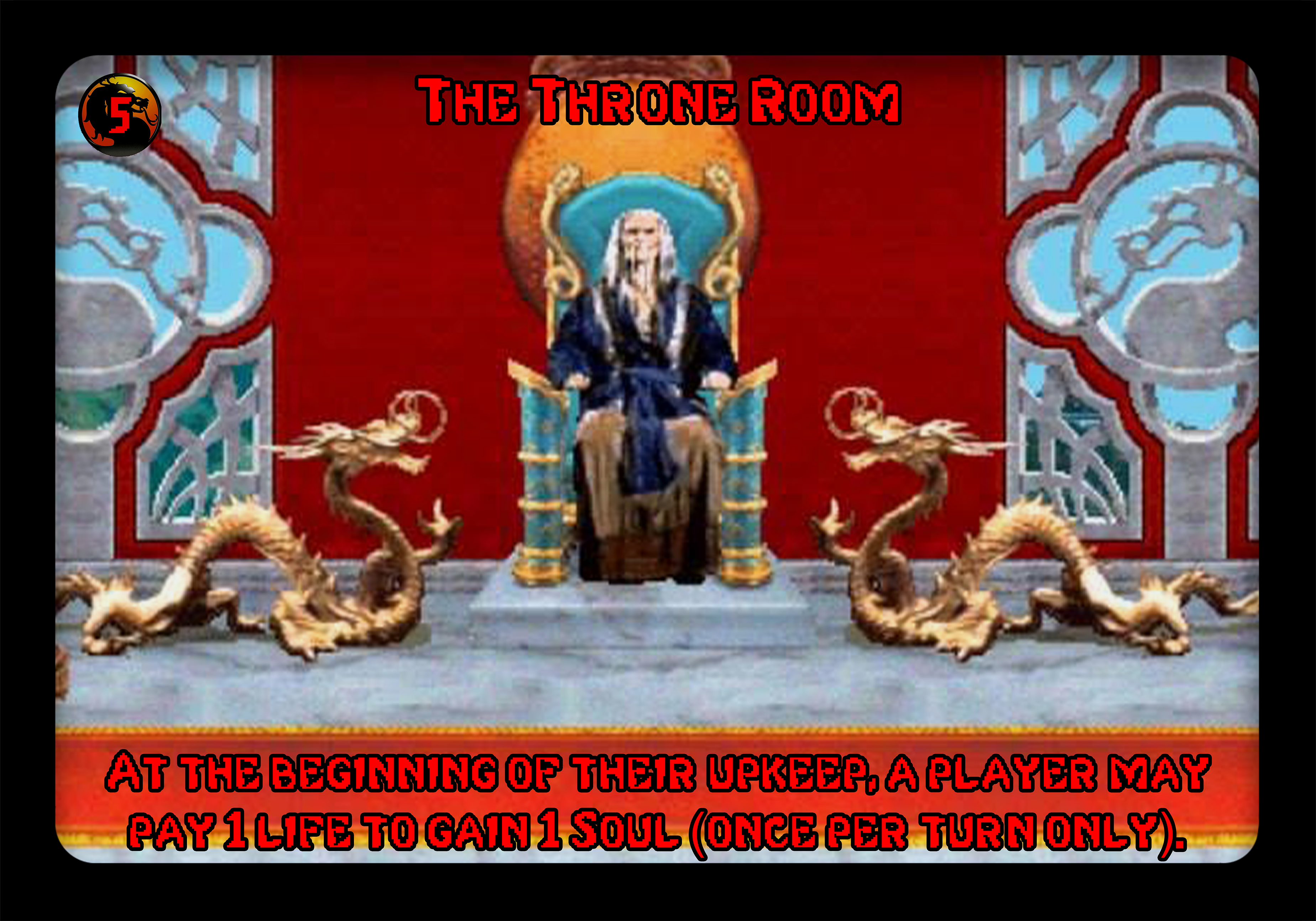
5. The Throne Room
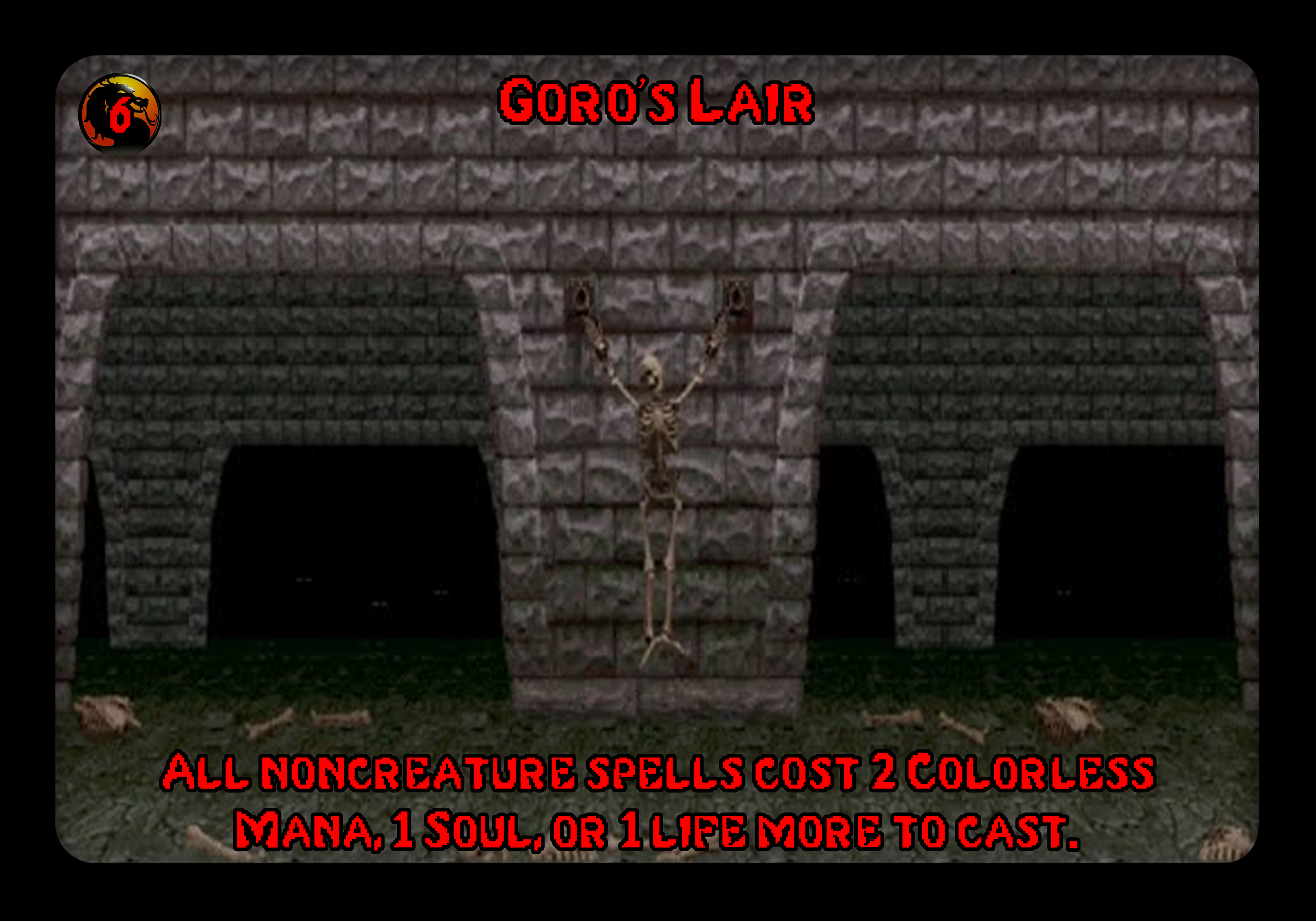
6. Goro's Lair
Winning the Tournament
After the allotted number of rounds (4-5), the player with the most Match Points wins the event. Extra Match Points earned through Fatalities are included in the total number of Match Points. In the event of a tie for first place, the player with the most Fatalities wins. If there is still a tie, the winner will be chosen by a final deathmatch. Other than first place, ties in final standings will be broken by standard tiebreakers (counting all bonus Fatality match points).
Toasty!
Any time a player reduces their opponent to exactly 0 life, they may yell "Toasty!" and receive a special sticker (limit 1 per tournament). This is purely for fun and has no effect on tournament outcome.
Revision History
- Feb 26
- Initial rules posting.